
Which Cancers Have the Lowest Survival Rates? Understanding the Clinical Challenges of High-Risk Cancers.

When discussing cancer, it is common to view it as a single disease. In reality, different types of cancer behave in very different ways.
Some cancers are more likely to be identified at an early stage, while others can be more difficult to detect and treat because of their location, biology, available screening methods, and response to treatment.
Understanding the Statistics: The 5-Year Net Survival Rate
The five-year net survival rate estimates the percentage of people who will survive for at least five years after a cancer diagnosis, accounting for other causes. These statistics describe outcomes across groups and cannot predict an individual prognosis.
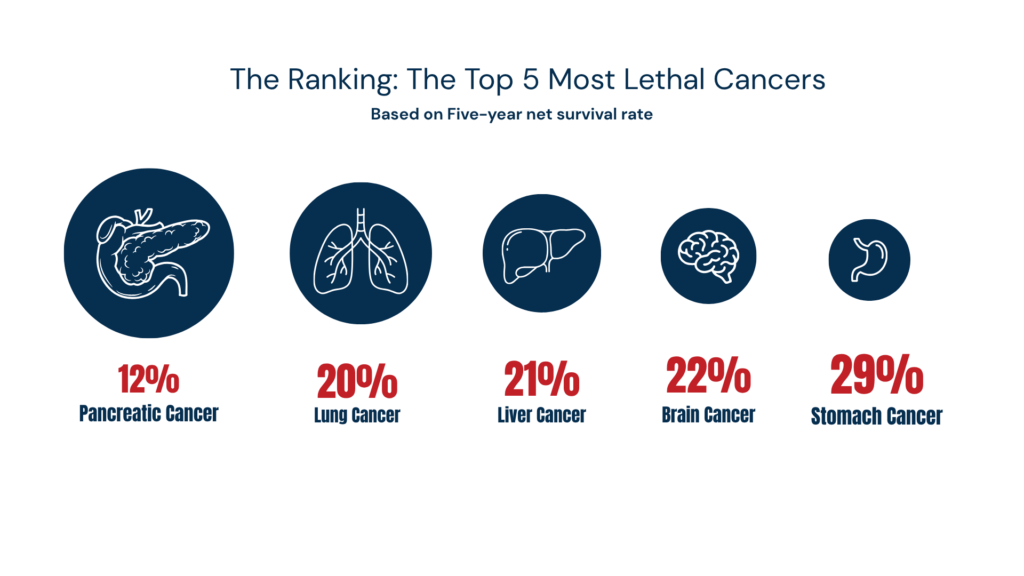
Pancreatic Cancer (12%): In Canada, the five-year net survival rate for pancreatic cancer is approximately 12%. Pancreatic cancer is often difficult to identify early because noticeable symptoms may not appear until the disease has progressed.
Lung Cancer (20%):
Though its five-year net survival rate has improved in recent years due to advances in diagnosis and treatment, outcomes still vary significantly by cancer type and stage at diagnosis.
Liver Cancer (21%): In Canada, the five-year net survival rate for liver cancer is approximately 21%. Liver cancer may not cause noticeable symptoms in its early stages, and underlying liver disease can also affect treatment and outcomes.
Why Are These Three Cancers Often Difficult to Detect and Treat?
Lung, pancreatic, and liver cancers can share several clinical challenges, including limited population screening, later diagnosis in some cases, complex tumour biology, and restrictions on available treatments.
1. The Detection Bottleneck: Canadian Screening Limitations
Unlike breast or colorectal cancers, which have widely available public screening programs across Canada, routine population-wide screening for pancreatic and liver cancer is not available for the general public.
- The screening gap: In Canada, there are currently no routine population-wide screening programs for pancreatic or liver cancer for people at average risk. Specialized surveillance may be recommended for certain individuals with inherited conditions, chronic liver disease, or other recognized risk factors.
- The Strict Lung Criteria: While provincial lung cancer screening programs exist (such as the BC Lung Screening Program and the Ontario Lung Screening Program), eligibility is limited to people at higher risk. It is based on factors such as age, health history, and an individual risk assessment.
- The Consequence: People who do not meet provincial eligibility criteria may not receive routine screening for these cancers. Because these organs are located deep within the body and early symptoms can be absent or non-specific, some cancers are not identified until a later stage, when treatment may be more complex. Persistent symptoms such as unexplained pain, jaundice, or a chronic cough should be discussed with a healthcare professional.
2. The Treatment Bottleneck
Once identified, the biology of these cancers can make treatment more challenging:
- Pancreatic cancer: Pancreatic tumours may be surrounded by dense, fibrous tissue that can affect how well certain therapies reach the tumour.
- Liver cancer: Some liver cancers may not respond well to traditional chemotherapy. Treatment options can also be affected by underlying liver disease, including cirrhosis.
- Lung cancer: Some lung cancers can develop genetic changes that affect their response or resistance to targeted therapies.
3. The Surgical Bottleneck
For some cancers, surgery may offer an opportunity for long-term cancer control and, in certain cases, curative treatment. However, because of the location of these organs, surgery may be complex or no longer appropriate when cancer is identified at a later stage.
- The pancreas is located close to major blood vessels. If a tumour involves these vessels or has spread, surgical removal may not be possible.
- Large sections of the liver may not be safely removed if the remaining tissue is affected by underlying disease.
- The amount of lung tissue that can be safely removed depends on lung function, cardiovascular health, tumour location, and stage.
Understanding Additional Testing Options and Their Limitations
When provincial programs do not provide routine screening for pancreatic, lung, or liver cancer, some people consider private testing. It is important to understand the potential benefits, limitations, and follow-up requirements of these options.
1. Private Whole-Body MRI
- What it is: A high-resolution, radiation-free scan that uses magnetic fields and radio waves to visualize internal organs, including the pancreas, liver, and lungs.
- How it works: Traditional imaging is generally ordered based on symptoms, risk factors, or clinical findings. A private whole-body MRI provides detailed images of the abdominal and chest areas and may identify structural abnormalities before symptoms appear. However, any findings require clinical evaluation and may not indicate cancer.
- The Investment: In Canada, a comprehensive private whole-body MRI scan typically ranges from $2,500 to $3,500 CAD out-of-pocket, depending on the provider and the depth of the protocol.
2. Multi-Cancer Early Detection (Cancer Blood Test)
- What it is: An emerging blood test designed to evaluate biological signals rather than physical anatomy. From one blood draw, it is designed to detect cancer-associated signals across up to 59 cancer types, including pancreatic, liver, and lung cancers.
- How it works: As some early-stage cancers grow, they may shed microscopic fragments called circulating tumour DNA (ctDNA) into the bloodstream. A simple blood draw allows these genetic fragments to be analyzed. If a biological signal is flagged, it may provide an early indication for further clinical evaluation and targeted imaging. A positive signal does not confirm a cancer diagnosis. A positive signal does not confirm a cancer diagnosis.
- The Investment: In Canada, multi-cancer early detection blood tests are available through private clinics such as Cancer Blood Test. The currently listed price is approximately $2,749 CAD per test.
Overcoming Treatment and Surgical Challenges: Why Timely Follow-Up Matters
For aggressive cancers such as pancreatic, lung, or liver cancer, timely evaluation and treatment can be important. These cancers can be biologically complex, and involvement of nearby blood vessels may affect whether surgical treatment is appropriate.
Private medical-navigation and advocacy programs may help reduce administrative delays by coordinating follow-up when an abnormality is identified. If a signal is detected through a cancer blood test or MRI, a clinical team may help arrange targeted diagnostic imaging and share relevant records with oncology specialists. This coordination can support a more timely transition from screening to further evaluation and discussion of appropriate treatment options.
This article is for general educational purposes only and does not constitute medical advice, diagnosis, or treatment. Screening recommendations vary by location and individual risk. Cancer blood tests and whole-body MRI should not be used to delay or replace established screening, diagnostic evaluation, or medical care recommended by a qualified healthcare professional.
